
Blog
How Long Does a First Copy Watch Last? — Honest Grade-by-Grade Answer

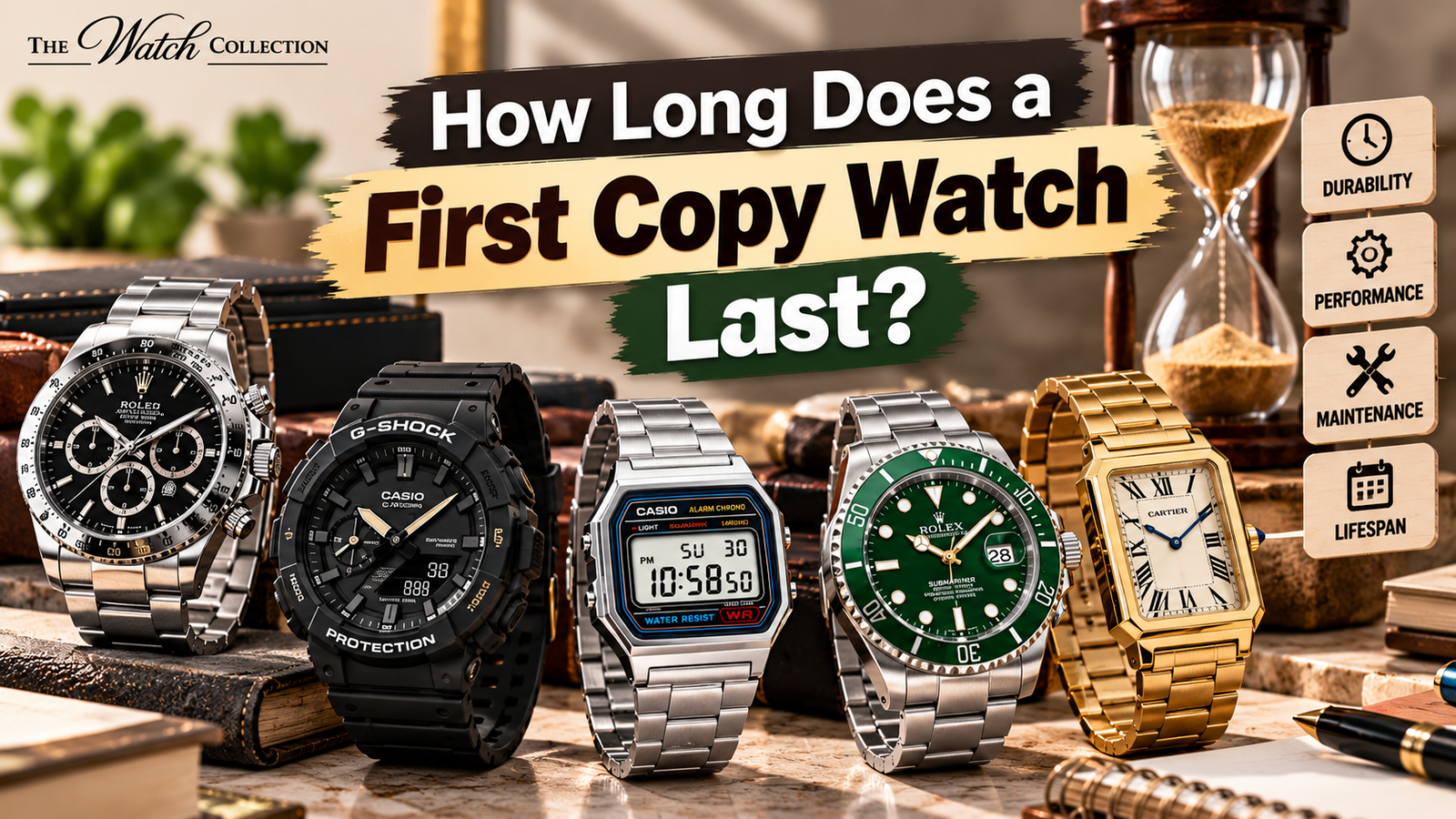
How Long Does a First Copy Watch Last?
A first copy watch lasts between 1 and 5+ years depending on quality grade — standard grade pieces last 1–2 years of regular daily wear, AAA quality lasts 2–4 years, and 7A quality pieces with proper care regularly last 5 or more years. Movement type, brand design complexity, and daily care habits also significantly affect how long any first copy watch holds up.
This is one of the most searched and least honestly answered questions in India’s first copy watch market. Most sellers either overclaim longevity to justify the price or give vague answers that leave buyers guessing. This guide gives the real, grade-specific breakdown that every buyer deserves before spending money.
Why Quality Grade Determines Lifespan More Than Brand
Before the grade-by-grade breakdown, one clarification that matters: the brand on the dial has almost no relationship to how long a first copy watch lasts. A ₹2,000 “Rolex” first copy and a ₹2,000 Fossil first copy are both standard grade — they use the same alloy quality, the same crystal type, and the same movement class. Brand is a design choice. Grade is a durability choice.
Understanding this distinction is what separates buyers who walk away satisfied from those who feel the market let them down. A first copy watch at 7A quality will consistently outlast a lower grade piece of the same brand by 2–3x. Grade is the only variable that reliably predicts longevity.
Standard Grade First Copy Watches — How Long They Last

Standard grade first copy watches last approximately 1–2 years of regular daily wear under normal conditions.
This is the honest baseline for the vast majority of pieces sold under ₹2,000 in India’s first copy market. At standard grade, the materials used are:
- Basic alloy cases — lighter, more susceptible to denting and surface scratching than higher grades
- Hollow bracelet links — these flex under regular wear and begin to loosen at the joints within 12–18 months of daily use
- Mineral glass crystal — scratches within months of regular wear, particularly in campus and outdoor environments
- Basic quartz movement — reliable for timekeeping but not serviced to the tolerances of higher grade movements
What typically fails first at standard grade:
- Bracelet links loosen and develop rattle — usually within 12–15 months of daily wear
- Crystal accumulates visible scratches — within 6–8 months in active daily use
- Crown mechanism becomes stiff or develops wobble — 12–18 months
- Dial printing fades or smudges on watches exposed to sweat and humidity regularly
Standard grade pieces are not poor value — they are correctly valued. A ₹800 G-Shock-style digital piece that works reliably for 18 months of daily campus wear has done exactly what it was purchased to do. The mistake is expecting 5-year longevity from a ₹1,200 purchase.
Best use case: Gifting, occasional wear, style exploration, college daily use where replacement cost is not a concern.
AAA Quality First Copy Watches — How Long They Last
AAA quality first copy watches last approximately 2–4 years of regular daily wear, with better-maintained pieces regularly reaching the upper end of this range.
At AAA quality, the production investment goes into the three areas that most directly affect durability:
- Solid bracelet links — the single most important durability upgrade over standard grade. Solid links hold their shape, articulate smoothly, and do not develop rattle under normal wear. This alone extends bracelet life from 12–18 months to 3–5 years.
- Improved alloy density — the case resists minor impacts better and maintains its shape through regular daily use without the denting risk of standard grade
- Mineral glass with improved hardness treatment — still not sapphire, but noticeably more scratch-resistant than standard grade crystal
- Reliable automatic or quartz movement — at AAA, automatic movements have better rotor bearings and more consistent timekeeping than standard grade equivalents
What typically determines where in the 2–4 year range a piece lands:
- Care habits — a AAA piece worn swimming, in dusty environments, or knocked regularly will trend toward 2 years. One worn carefully in everyday social and professional contexts regularly reaches 3–4 years.
- Movement type — AAA quartz pieces tend to outlast AAA automatics at this grade because quartz has fewer moving components that can wear
- Brand reference — simpler dial designs (Tissot, Rado, Fossil) have fewer components under stress than complex chronograph references where pushers and subdial mechanisms add wear points
First copy watches for men and first copy watches for women at AAA quality are the sweet spot for most buyers — the 2–4 year lifespan at a ₹2,500–₹6,000 price point represents genuinely good value when amortised over daily use.
7A Quality First Copy Watches — How Long They Last
7A quality first copy watches regularly last 5 or more years of daily wear when given basic maintenance — and well-maintained pieces have been worn daily for 7–8 years without requiring replacement.
At 7A quality, the production standard changes fundamentally:
- Dense alloy cases — the same weight class and material resistance as entry-level genuine luxury watches. Case integrity holds through years of daily wear without meaningful surface degradation.
- Sapphire-coated crystal — the closest available equivalent to genuine sapphire in the first copy market. Day-to-day scratching that would visibly mark a standard or AAA crystal leaves 7A crystal essentially unmarked.
- Solid brushed and polished bracelet links — built to the finishing tolerance that genuine luxury watches use. These do not loosen under daily wear and maintain their appearance through years of use with normal cleaning.
- Refined automatic movement — rotor bearing quality and movement tolerance at 7A produce consistent timekeeping within 10–15 seconds per day and a winding feel that holds up through years of regular wear
What affects longevity at 7A:
- Water exposure — even 7A first copies are not rated for submersion. Regular water contact at the crown accelerates wear on the gasket and crown mechanism. Keep the crown wound and secured.
- Magnetic fields — automatic movements at any grade are susceptible to magnetisation, which causes erratic timekeeping. Store away from speakers, phone charging pads, and refrigerator magnets.
- Service interval — a 7A automatic movement benefits from a light service every 3–5 years, similar to any mechanical watch. This is available from local watch repair shops for ₹500–₹1,500 depending on the movement.
First copy luxury watches at 7A quality represent the strongest long-term value in the first copy market — a ₹8,000–₹15,000 piece that lasts 5–8 years of daily wear amortises to less than ₹5 per day.
Movement Type and Lifespan — Quartz vs Automatic

Movement type has a direct effect on longevity that grade alone does not capture.
Quartz movements — battery-powered, single oscillating crystal, minimal moving parts. Quartz first copy watches at any grade are more durable day-to-day than their automatic equivalents because fewer components can wear. A good quartz movement at AAA quality is genuinely reliable for 3–5 years without any service. Battery replacement (₹100–₹200 at any watch shop) every 1.5–2 years is the only maintenance required.
Automatic movements — mechanical, rotor-wound, multiple precision components. First copy automatic watches at 7A quality are genuinely satisfying to wear and maintain well — but they require slightly more care than quartz. Wear the watch daily (or use a watch winder if not worn for several days) to keep the movement running. Service every 3–5 years keeps the movement in good condition over the long term.
The practical implication: if longevity with zero maintenance is the priority, choose quartz. If the mechanical experience and sweeping seconds hand matter more than convenience, choose automatic at 7A grade specifically — the movement quality at lower grades does not reward the added maintenance.
How Care Habits Affect First Copy Watch Lifespan
The difference between a first copy watch lasting 2 years and 4 years is often entirely in how it is worn and stored — not in the piece itself.
Five habits that extend first copy watch lifespan meaningfully:
- Remove before water exposure — first copy cases use gaskets that degrade faster than genuine luxury equivalents. Removing the watch before swimming, showering, or washing dishes extends crown and caseback gasket life by years.
- Store in a watch box or pouch — crystal-to-crystal or crystal-to-surface contact while stored in a drawer is the fastest way to accelerate scratch accumulation. A basic cloth pouch prevents years of unnecessary wear.
- Clean the bracelet regularly — sweat and dust accumulate in bracelet link joints and accelerate wear on the hinge pins. A monthly wipe with a soft cloth and mild soap keeps links articulating smoothly.
- Avoid extreme temperature changes — leaving a watch on a hot car dashboard or in a cold environment and then wearing it in contrasting temperatures accelerates gasket and crystal adhesive degradation.
- Wind automatic movements properly — do not over-wind. Most first copy automatic movements have a slip-clutch, but over-winding repeatedly accelerates mainspring wear over time.
Lifespan Summary — All Grades at a Glance
- Standard Grade (₹500–₹2,500) — 1 to 2 years of regular daily wear. Bracelet and crystal are the first failure points. Best for gifting, occasional use, and style testing.
- AAA Quality (₹2,500–₹6,000) — 2 to 4 years of regular daily wear. Solid links and better crystal extend lifespan significantly. The right choice for most regular daily-wear buyers.
- 7A Quality (₹6,000–₹15,000+) — 5 or more years with basic care. Sapphire crystal, dense alloy, refined movement. The best long-term value in the first copy market when amortised over daily use.
For buyers exploring the first copy watches under ₹3,000 range, AAA quality in the upper end of that bracket is the practical target — the lifespan improvement over standard grade is immediate and noticeable. For buyers willing to step into 7A grade, the combination of mechanical experience and genuine longevity is the strongest value proposition in the entire category.
Final Thoughts
A first copy watch lasts exactly as long as its grade, care, and purpose allow. Standard grade pieces worn daily in demanding conditions will not reach two years — and should not be expected to. 7A quality pieces worn with basic care regularly outlast the expectations of buyers upgrading from the standard grade tier. The single most useful thing any buyer can do before purchasing is match the grade to the intended use — not just the brand to the aesthetic preference.
Frequently Asked Questions
Q: How long does a first copy watch last in India?
A first copy watch lasts 1–2 years at standard grade, 2–4 years at AAA quality, and 5+ years at 7A quality under regular daily wear. Lifespan depends primarily on quality grade, movement type, and basic care habits rather than the brand name on the dial.
Q: Which first copy watch grade lasts the longest?
7A quality lasts the longest — typically 5 or more years of daily wear with basic maintenance. The dense alloy case, sapphire-coated crystal, and refined automatic movement all contribute to durability that significantly exceeds standard and AAA grade pieces.
Q: Does a first copy automatic watch last as long as a quartz one?
At the same grade, quartz first copy movements typically outlast automatic movements because they have fewer moving components. However, a 7A automatic maintained with regular wear and a 3–5 year service interval is genuinely long-lasting — the tradeoff is care and occasional servicing versus the quartz watch’s lower-maintenance reliability.
Q: What is the most common reason first copy watches stop working early?
At standard grade, the most common failure points are bracelet link loosening, crown mechanism stiffness, and crystal scratching. At AAA and 7A grade, neglecting to keep automatic movements wound and exposing the watch to regular water ingress through the crown are the most common causes of early failure.
Q: Can a first copy watch be repaired if it stops working?
Yes. Quartz first copy watches can have their batteries replaced at any local watch repair shop for ₹100–₹200. Automatic first copy movements can be serviced by a local watchmaker for ₹500–₹1,500 depending on the movement complexity. Crystal replacement is also available at most repair shops for ₹200–₹800.
Q: Is a 7A quality first copy watch worth buying for daily wear?
Yes — at 7A quality, the combination of dense case construction, sapphire-coated crystal, and refined automatic movement produces a watch genuinely suitable for daily wear over a multi-year period. Amortised over 5–7 years of daily use, the cost per day of a 7A first copy watch is lower than most standard grade pieces replaced every 1–2 years.
Read More: Top 10 Casio Watches Under ₹2,000 in India (2026 Guide)