
Blog
Is First Copy Watches Worth Buying? An Honest Answer for Indian Buyers

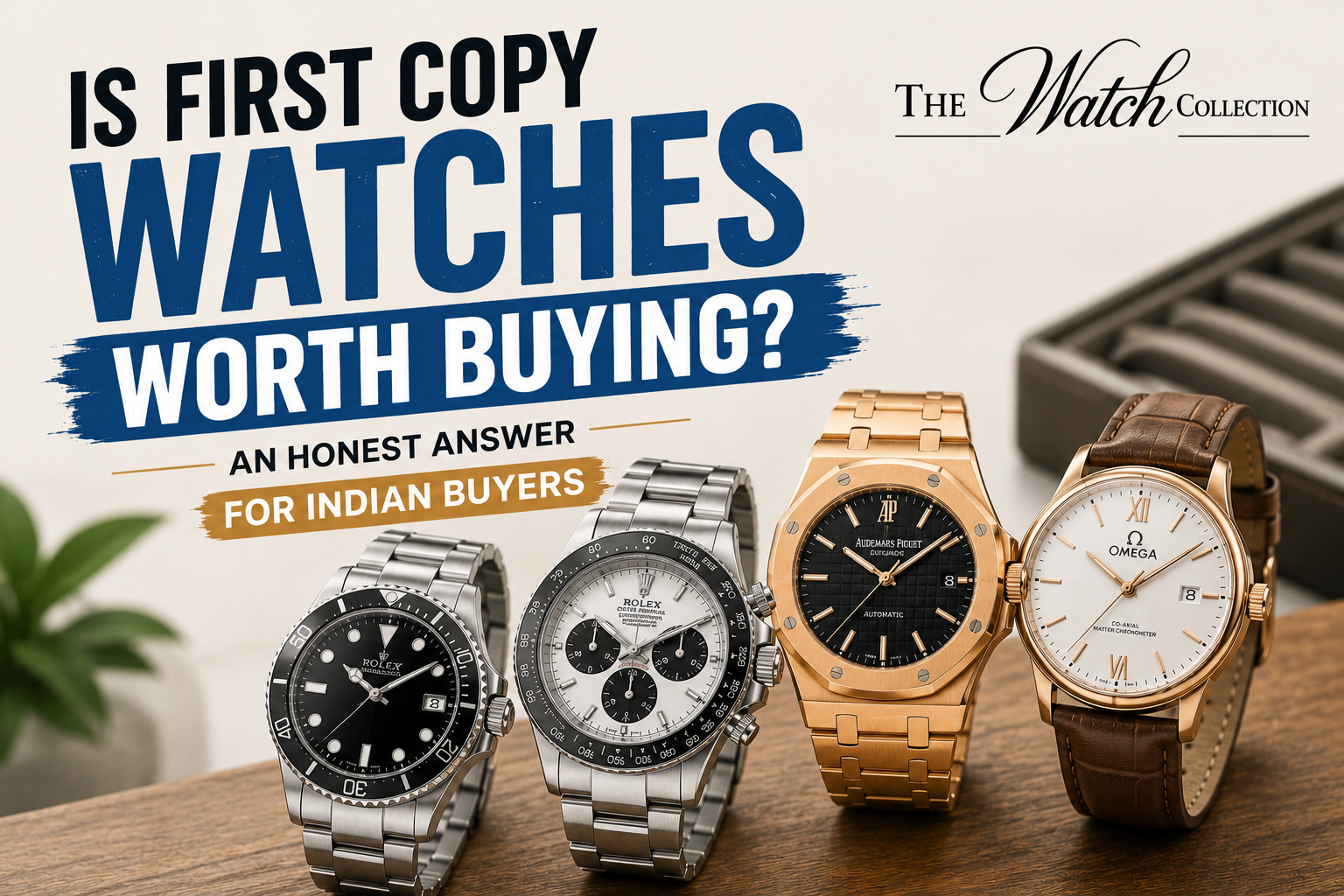
Is First Copy Watches Worth Buying?
Yes — first copy watches are worth buying, but only when the buyer understands what they are purchasing. A quality-graded first copy watch delivers accurate brand design, a satisfying wearing experience, and genuine everyday value at 1–5% of the original’s price. The disappointments in this category do not come from the category itself — they come from mismatched expectations, wrong grade choices, and unreliable sellers.
That is the honest answer. Everything below explains what sits behind it.
What Makes a First Copy Watch “Worth It”

The word “worth” depends entirely on what a buyer is measuring value against. If the measure is “does it look like the original” — a quality first copy scores extremely well. If the measure is “does it have the same movement engineering as a Swiss chronometer” — it does not, and nothing priced between ₹1,000 and ₹10,000 ever will.
Most buyers shopping for replica watches are measuring the first thing, not the second. They want a Rolex Submariner look on their wrist. A Tissot PRX silhouette. An Omega Seamaster wave dial. A Michael Kors crystal bracelet watch. They want those specific design identities — not the movement inside, not the brand history, not the investment value. For this specific purpose, a quality first copy is not just “worth buying” — it is the most direct and honest way to achieve exactly that goal.
The category fails buyers who come in expecting the original’s engineering at the replica’s price. It consistently satisfies buyers who come in knowing what the trade-off is and choosing it deliberately.
When First Copy Watches Are Absolutely Worth Buying
There are specific contexts where buying a first copy watch is not just reasonable but genuinely the smart decision.
When you want a specific look without a specific budget
A Patek Philippe Nautilus original starts above ₹40,00,000. A Rolex Daytona original retails above ₹15,00,000. A Hublot Big Bang original crosses ₹8,00,000. These are not watches that a meaningful percentage of buyers will ever own at retail, regardless of their income level. If the design of one of these pieces genuinely appeals to you — the silhouette, the dial layout, the wrist presence — a quality first copy delivers that design honestly and accessibly.
When you want to try a brand’s aesthetic before committing further
Some buyers use first copy watches as a form of considered trial. Spending ₹3,000 to ₹5,000 on a AAA quality first copy of a Tissot or Rado reference they are considering gives them months of real wrist time with a brand’s design language before making any larger investment decision. This is a genuinely sensible way to approach watch buying.
When gifting makes more sense than spending
A ₹1,500 to ₹3,000 first copy watch makes an excellent gift for a colleague, a student, a sibling, or anyone who would appreciate a stylish, branded-looking piece without the giver spending disproportionately. First copy watches for men and first copy watches for women across fashion brands — Fossil, Tommy Hilfiger, Armani Exchange — are particularly well-suited to gifting precisely because the designs are widely appealing and the price-to-presentation ratio is strong.
When daily wear on an original would create anxiety
Some buyers own genuine luxury watches but choose a first copy for specific contexts — construction sites, outdoor activities, travel to unfamiliar places, festivals — where the risk of damage, theft, or loss makes wearing an expensive original a source of genuine anxiety rather than pleasure. A ₹4,000 to ₹7,000 7A quality first copy as a “beater” piece for these contexts is a completely rational choice.
When First Copy Watches Are NOT Worth Buying
Honesty requires addressing the other side too.
When you are expecting the original’s engineering
A first copy watch will not keep time within 2 seconds a day like a certified chronometer. A first copy automatic movement will not run for 48+ hours on a full wind. A first copy sapphire crystal, even at 7A quality, is not the same hardness as Rolex’s own crystal. If movement engineering, horological precision, or long-term mechanical durability are what matter most, no first copy delivers those things and it would be misleading to suggest otherwise.
When investment or resale value matters
Original luxury watches — particularly Rolex, Patek Philippe, and Audemars Piguet — have well-established secondary markets and genuine resale value. Some references appreciate significantly over time. A first copy watch has no resale value beyond whatever the next buyer is willing to pay for a replica, which is typically a fraction of what was paid originally. Buyers thinking about watches as assets should not be looking at this category.
When status verification is part of the goal
Serious watch collectors and enthusiasts can identify most quality-grade first copies through close inspection. The case weight on a 7A piece is convincing; a genuine expert comparing specific dial details or movement finishing with a reference image will typically find tells. If being able to withstand expert scrutiny matters specifically — for a professional environment where watch knowledge is common, for example — a first copy will not reliably survive that level of examination.
How Quality Grade Determines Whether It’s Worth Buying
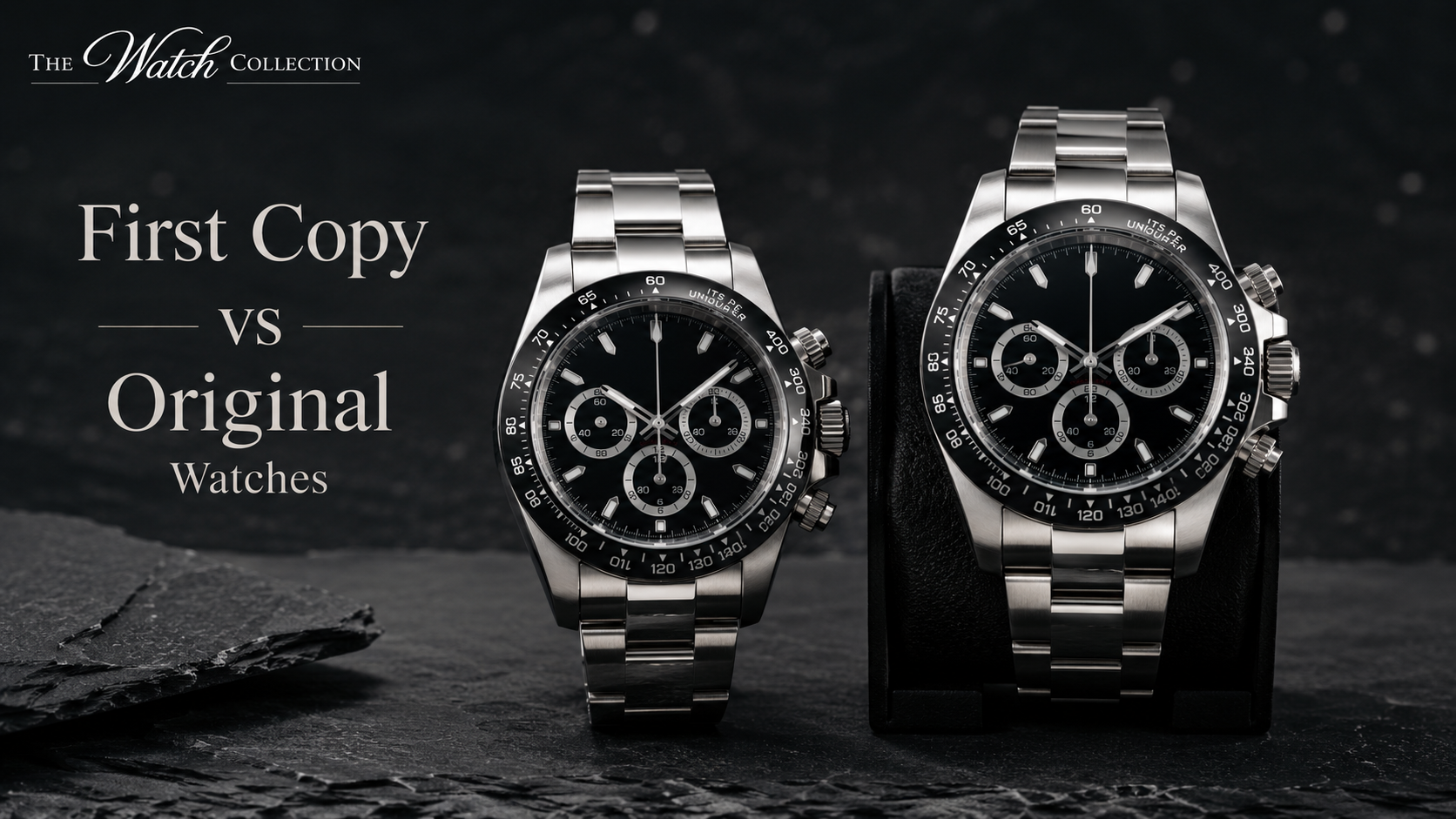
First Copy vs Original Watches — Spot the difference in craftsmanship, detailing, and overall finish with The Watch Collection.
This is where most “is it worth it” questions actually get resolved. The grade of the first copy matters far more than the brand or the price point.
Standard Grade (₹500–₹2,500): Worth buying for casual wear, gifting, and simple digital or fashion-brand designs. Not worth buying as a convincing luxury brand replica — the design complexity of Swiss references exposes standard grade limitations immediately.
AAA Quality (₹2,500–₹6,000): Worth buying for most buyers and most purposes. Solid bracelet links, improved dial accuracy, automatic movement options. The sweet spot of the first copy market — genuine quality that delivers a satisfying daily wear experience across the majority of popular brand references.
7A Quality (₹6,000–₹15,000+): Worth buying for buyers who specifically want the closest available match to an original’s physical characteristics — case weight, bracelet finishing, movement feel, crystal clarity. First copy luxury watches at this grade are the most convincing available and represent the top of what the first copy market can offer.
For buyers exploring budget options, first copy watches under ₹3,000 at AAA grade are the entry point where the experience becomes genuinely good rather than merely adequate.
Which Brands Give the Best Value as First Copies
Not every brand translates equally well into first copy form, which affects the “worth it” calculation brand by brand.
High value: Tissot, Rado, Fossil, Tommy Hilfiger, G-Shock, Casio Edifice — simpler, cleaner designs that reproduce accurately even at AAA grade, where most buyers can spend comfortably.
Strong value at the right grade: Rolex first copy, Omega, Tag Heuer — these need AAA minimum and ideally 7A to be convincing. At the right grade, they are among the most satisfying first copies available.
Worth it only at 7A: Patek Philippe Nautilus, Richard Mille, Audemars Piguet Royal Oak — complex design elements (embossed dials, integrated bracelets, skeletonised architecture) that expose lower grades noticeably. Absolutely worth it at 7A quality, where the design accuracy is impressive.
Worth it as fashion statement, not precision replica: Gucci, Versace, Just Cavalli — bold, pattern-driven designs where graphic clarity matters more than fine engineering detail. Deliver well at AAA grade.
What Makes the Buying Experience Worth It — Seller Matters as Much as Grade
One of the most underappreciated factors in whether a first copy watch purchase feels “worth it” is the seller experience itself. A buyer who receives a well-described, accurately graded piece with correct product photography, clear return terms, and responsive post-sale support has a fundamentally different experience than one who buys blind from a vague listing and receives something that does not match expectations.
This is why grade clarity, real product photography, and a documented return policy are worth prioritising above marginal price differences. Paying ₹200 more for a piece from a seller who describes their stock honestly is almost always a better outcome than paying ₹200 less from one who does not.
First copy automatic watches particularly reward careful seller selection — because the movement is the most expensive component to source well, it is also the component that budget sellers are most likely to compromise on while still claiming the same grade label.
The Straightforward Verdict
First copy watches are worth buying for the majority of buyers who understand what the category offers: the design identity of branded watches at an accessible price, with a quality floor that rises significantly once you move above standard grade.
They are not worth buying for buyers who need the original’s engineering, investment value, or the ability to survive expert scrutiny. That is a small minority of the watch-buying population — and it is the group for whom original watches exist.
For everyone else — which is most buyers — a quality-graded first copy from a transparent, accountable seller is a genuinely good purchase. Not a compromise. A deliberate, well-informed choice.
Frequently Asked Questions
Q: Is first copy watches worth buying in India?
Yes, for buyers who want a specific brand’s design at an accessible price. First copy watches deliver accurate visual identity, satisfying daily wear, and genuine value when bought at AAA or 7A quality grade from a transparent seller. They are not worth buying for buyers seeking original engineering, investment value, or expert-proof authenticity.
Q: Are first copy watches good quality?
Quality varies significantly by grade. Standard grade (₹500–₹2,500) is adequate for casual use. AAA quality (₹2,500–₹6,000) offers solid bracelet links, sharp dial printing, and automatic movement options — suitable for regular daily wear. 7A quality (₹6,000+) delivers the closest available match to an original’s case weight, crystal, and movement feel.
Q: How long do first copy watches last?
At standard grade, expect one to two years of regular casual use. At AAA quality, two to four years of daily wear is realistic with normal care. At 7A quality, longevity is closer to the higher end — some buyers report five or more years of daily use from well-maintained 7A automatic pieces. Automatic movements require more care than quartz, regardless of grade.
Q: What is the difference between a first copy and a fake watch?
A first copy watch is sold openly as a replica — both buyer and seller know exactly what is being purchased. A fake or counterfeit watch is deliberately sold as a genuine original to deceive the buyer. The first copy market operates on transparency; the counterfeit market operates on misrepresentation. These are fundamentally different transactions.
Q: Which first copy watch brand gives the best value for money?
Tissot, Fossil, G-Shock, and Rado-style pieces give the best value at AAA grade because their designs reproduce accurately without requiring 7A-level precision. For buyers willing to spend more, Rolex first copy at 7A quality delivers exceptional design accuracy for one of watchmaking’s most celebrated references.
Read More:- First Copy Watches Wholesale Market in Mumbai — A Complete Buyer’s Guide
